Funding advances a blood-based epigenomic platform designed to give drug developers a scalable view into how disease and treatment change human biology.
HELSINKI, Finland, and CAMBRIDGE, Massachusetts — Nov 10, 2026 — Modern medicines increasingly target precise biological mechanisms, yet once treatment begins, it can be difficult to see how an individual patient’s underlying biology is actually changing and why one patient responds while another does not. Clinical endpoints can take months or years to read out, tissue biopsies are invasive and difficult to repeat, and conventional blood biomarkers often track outcomes without explaining the biology behind them.
Switchpoint Bio today announced $5.3 million in pre-seed financing to advance a new way to measure those changes from blood. The round includes a $5 million investment from Treehouse Delmar Investments.
Biology leaves a record in blood
Circulating immune cells carry epigenomic marks of disease, exposures and treatment. Switchpoint Bio combines precision epigenomic profiling and AI to read that record, with the aim of giving drug developers a scalable view into how disease and treatment change human biology.
For drug developers, treatment response provides an immediate application: What biology is present before treatment? What changes after a drug is given, by how much, and in what way? What persists despite treatment? Making those changes measurable over time could provide an earlier and more direct view of mechanism, response and resistance, helping drug developers understand which patients benefit, which do not, and why.
“Drug developers need to know not only whether a patient responds, but what biology changed, what persisted and why,” said Samuel Myllykangas, PhD, Co-Founder and Chief Executive Officer of Switchpoint Bio. “Our goal is to make these biological switchpoints visible from a routine blood sample, repeatedly and at the scale required for drug development.”
From deep cellular biology to a scalable blood measurement
Recent advances in epigenomics, single-cell biology, population-scale datasets and AI are making it possible to connect scalable blood measurements to the underlying cellular biology of disease.
Single-cell multiomic technologies can characterize cellular biology in deep detail, but typically require fresh samples, complex cell processing and specialized laboratory workflows, making them difficult to deploy repeatedly across the number of patients and timepoints required in clinical development.
Switchpoint Bio is developing a scalable approach based on targeted DNA methylation profiling directly from blood. Its assay focuses on epigenomically active regions relevant to disease and immune biology, giving deep, cost-efficient coverage of the parts of the methylome that matter most for drug development.
The company is now moving from platform development into clinical and industry validation. Switchpoint Bio is testing its approach in autoimmune disease, including systemic lupus erythematosus (SLE), to determine whether disease-relevant immune states can be identified epigenomically from blood and followed longitudinally through treatment.
In parallel, Switchpoint Bio is in active discussions with pharmaceutical and biotechnology companies to define its first industry validation programs, with treatment response emerging as a key area of interest.
“We take a long-term view, backing science we believe can genuinely change how disease is understood and treated,” said Dave Proctor of Treehouse Delmar Investments. “Switchpoint Bio brings together exceptional scientific talent with a real path to turning breakthrough biology into evidence that helps patients, and we’re proud to support that work.”
The financing will support continued clinical and industry validation, expansion of the company’s clinical and biobank datasets, further development of its epigenomic and AI platform, and growth of its scientific and technical team across Helsinki and Cambridge.
Built at the intersection of genomics, epigenomics and drug development
Switchpoint Bio was founded by Samuel Myllykangas, PhD, and Jason Buenrostro, PhD, collaborators since developing targeted sequencing technologies together at Stanford University. Buenrostro, a MacArthur Fellow, is a professor at Harvard University, Director of the Epigenomics Program at the Broad Institute of MIT and Harvard, and inventor of ATAC-seq, a foundational epigenomic profiling technology. Myllykangas previously built and scaled Blueprint Genetics, which was acquired by Quest Diagnostics in 2020.
They were joined by three co-founders: Niilo Färkkilä, PhD, Chief Commercial Officer, who brings pharmaceutical industry experience from Amgen and GSK; Jussi Paananen, PhD, Chief Technology Officer, who previously served as CTO at Blueprint Genetics; and Mitja Kurki, PhD, Scientific Advisor, who brings experience in population genomics and pharmaceutical data platforms from FinnGen, a nationwide biobank study spanning more than 500,000 participants. Paananen and Kurki have both previously worked as scientists at the Broad Institute of MIT and Harvard.
About Switchpoint Bio
Switchpoint Bio is building a blood-based epigenomic platform to give drug developers a scalable view into how disease and treatment change human biology. By combining precision epigenomic profiling with single-cell reference biology, population-scale datasets and AI, the company aims to turn the biological record carried in blood into actionable insights for drug development, helping researchers understand treatment response, patient differences and disease biology.
Switchpoint Bio is based in Helsinki, Finland, and Cambridge, Massachusetts, USA.
For more information, visit switchpointbio.com.
Media Contact
Samuel Myllykangas, PhD
Co-Founder and Chief Executive Officer
Switchpoint Bio
samuel.myllykangas@switchpointbio.com
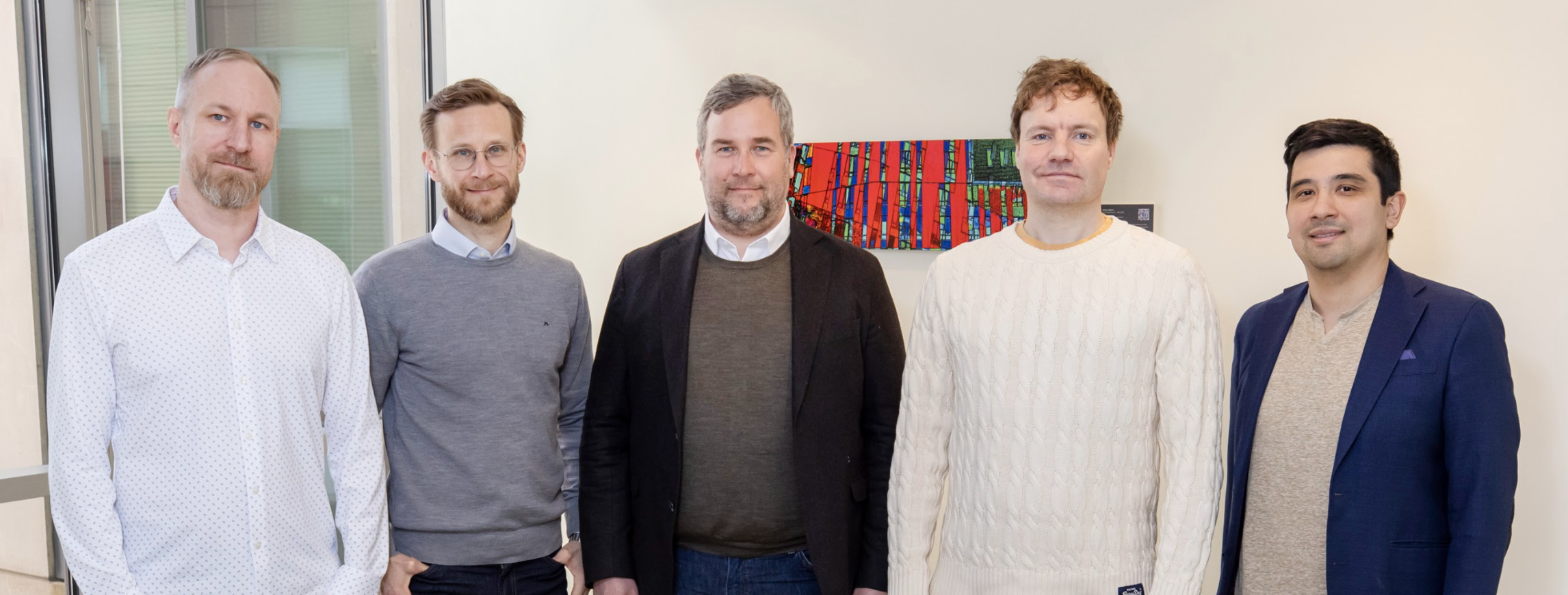
Switchpoint Bio's founding team. From left: Jussi Paananen, PhD (Chief Technology Officer); Niilo Färkkilä, PhD (Chief Commercial Officer); Samuel Myllykangas, PhD (Chief Executive Officer); Mitja Kurki, PhD (Scientific Advisor); Jason Buenrostro, PhD (Scientific Advisor).